Floating Shelves vs Bracket Shelves: Which Should You Choose?
Every shelf project starts the same way: a wall that needs to work harder, a pile of books or a row of spice jars, and a quiet suspicion that one type of shelf will look better than the other. Then you start shopping, and the choice narrows to two. A floating shelf, which appears to hover with nothing holding it. Or a bracket shelf, where the support is part of the design. Both work. They work differently, and the right pick for your kitchen, hallway or study depends on what you are putting on it — and how much you enjoy drilling holes.
The answer rarely comes down to which type is objectively better. It comes down to what your wall can take, what your shelf needs to hold, and how much visual clutter you want below the shelf line. Once you understand those three things, the decision usually makes itself.
What the two types actually are
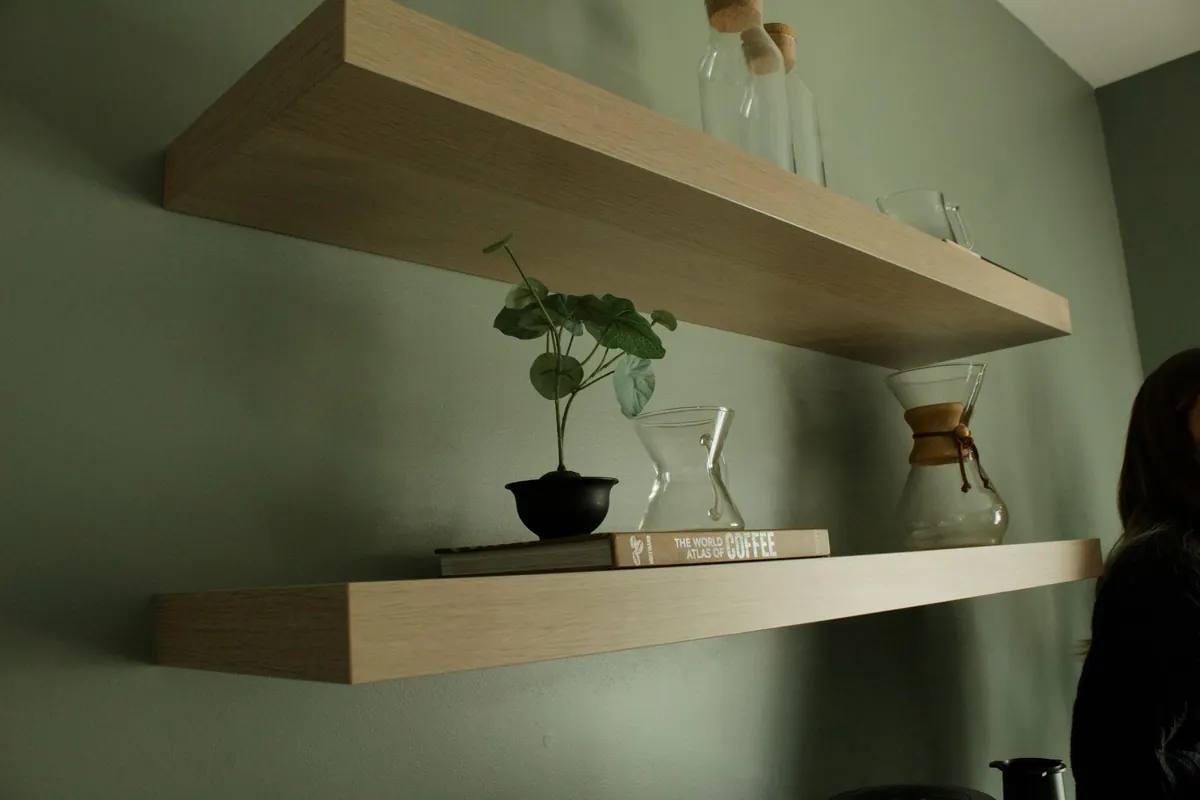
A floating shelf conceals its support inside the shelf itself: a steel rod on a wall plate, a pair of hidden brackets, or a metal frame that screws to the wall and slots into a hollowed-out section of timber. You see the shelf, the wall and a slim shadow underneath. Nothing else.
A bracket shelf puts the support on show. Two L-shaped brackets, or a pair of decorative cast-iron ones, sit underneath and carry the load. The shelf rests on top and is usually screwed down from above.
That single difference — hidden support versus visible support — shapes the look, the load capacity, the cost and the effort involved. It also affects how easy the shelf is to adjust later. Floating shelves tend to be more permanent once installed. Bracket shelves can be moved, re-spaced or upgraded with different brackets without replacing the whole shelf.
Looks: clean lines versus visible character
Floating shelves are the quieter option. A run of them above a desk, in a kitchen or across an alcove reads as one clean horizontal line, which is why they suit modern, Scandi and small-space schemes so well. With no weight hanging below the shelf, the whole wall feels lighter. In a narrow hallway or a compact kitchen, that openness can make a real difference.
The trade-off is that floating shelves are unforgiving. They have to be level and evenly spaced, because a wobble or an uneven gap is obvious against a plain wall. A floating shelf that has started to sag at the front is a sad sight, and there is no easy fix. You cannot simply tighten a bracket or add a support underneath without changing the look.
Bracket shelves bring texture. Black metal, brass, painted timber or pipework can carry a cottage, period or workshop look, and the brackets become a feature in their own right. They are also easier to adjust later if you change your mind about spacing. If you want a shelf that looks built-in rather than bought, floating wins. If you want a shelf that looks like it belongs in a farmhouse kitchen or an industrial studio, brackets win.
Spacing that works
Leave roughly 30–35 cm between shelves for hardbacks, folders and cookbooks. About 20 cm is plenty for paperbacks, spice jars and small plant pots. Keep the top shelf far enough below the ceiling to lift the tallest item on and off easily. A common mistake is to space shelves evenly for looks but forget that the bottom shelf needs extra clearance for the tallest object you plan to store.
Load capacity: what each type will hold
Four things decide how much a shelf carries: the wall behind it, the fixings, the shelf material and the span between supports. That applies to both types.
If a shelf is going to hold more than a few kilograms, the wall it is fixed to matters more than the shelf you bought.
Solid brick or blockwork is the easiest wall to work with, provided you use fixings matched to the material. Plasterboard on battens or dot-and-dab is the opposite: the plasterboard itself will pull away under load unless you find the studs or use proper hollow-wall anchors. For a floating shelf, the hidden rod or bracket must reach solid timber or masonry; otherwise the shelf may feel secure for a week and then droop. For a bracket shelf, you can sometimes spread the load across four fixings per bracket, but if the bracket is only in plasterboard, keep the contents light.
Span matters too. A floating shelf longer than about 90 cm without a central support is asking for trouble, especially in MDF or thin timber. Bracket shelves handle longer runs better because you can add a bracket every 60–80 cm, and the shelf is supported from below rather than relying on a hidden internal spine.
As a rough guide, a well-installed floating shelf might hold 10–15 kg if it is short, thick and fixed into studs. A bracket shelf of similar timber, fixed into the same studs, can often take 25–40 kg or more because the brackets carry the weight directly. Treat those numbers as starting points, not promises: always check the manufacturer's rating and the condition of your wall.
Material changes everything. MDF is smooth and stable but can sag over time under heavy books. Pine is light and affordable but softer. Oak, birch plywood and other hardwoods are stronger and hold their shape better. Thicker shelves — 4 cm or more — look more substantial and resist bowing, especially over longer spans.
Installation: hidden hardware versus visible brackets
Floating shelves are fussier to install. You need to find studs or solid wall, mark a perfectly level line, drill accurately, and often slide the shelf onto rods or a bracket plate without cracking the plaster. Some systems require you to hollow out the back of the shelf or fit a metal frame inside. If the wall is uneven, a floating shelf can show gaps that a bracket shelf would hide.
Bracket shelves are more forgiving. You can hold the shelf in place, mark through the bracket holes, drill, and screw the brackets to the wall. Then you fix the shelf to the brackets from above or below. If you make a small mistake, you can often adjust the bracket position or add a shim. The visible brackets also let you see exactly where the load is going, which is oddly reassuring.
Both types need the same basic rule: fix into something solid. Use masonry plugs for brick and block, heavy-duty hollow-wall anchors for plasterboard if no stud is available, and screws long enough to bite without splitting the shelf. Pilot holes prevent splitting, especially near the ends of solid timber.
Where each type makes sense
In a kitchen, floating shelves keep the look open and let tiles or paint do the talking. Use them for mugs, jars, small plants and cookbooks you actually use. For cast-iron pans, stand mixers or a full set of hardbacks, bracket shelves are the safer choice.
In a hallway or boot room, bracket shelves add character and can hold baskets, hats and heavier everyday clutter. A floating shelf can work above a console table, but keep it for lighter decorative pieces.
In a study or living room, floating shelves create a clean backdrop for framed prints, small sculptures and a few favourite books. Bracket shelves suit a wall of paperbacks, vinyl records or reference books. In a bathroom, floating shelves look sleek for towels and toiletries, but choose moisture-resistant timber or sealed MDF, and fix into studs because humidity plus weight is a bad combination.
For renters or anyone who changes their mind often, bracket shelves are the friendlier option. They are easier to remove, and the holes are usually no worse than those left by floating shelf hardware.
A quick decision checklist
- What will the shelf hold? Light decor and jars favour floating; heavy books, tools and cookware favour brackets.
- What is the wall made of? Solid masonry is ideal for either; plasterboard needs studs or heavy-duty anchors.
- How long is the shelf? Short spans suit floating; long spans need brackets or extra support.
- How important is the look? Clean and minimal points to floating; industrial, rustic or period character points to brackets.
- How confident are you with a drill? Brackets are more forgiving; floating shelves demand precision.
The bottom line
Choose a floating shelf when you want an unbroken line, the contents are light to medium, and you are willing to install it carefully. Choose a bracket shelf when you need strength, adjustability and a bit of visible personality. Neither is automatically better. The best shelf is the one that matches your wall, your load and the look you want to live with — without sagging six months later.
Photo: Avery Arwood / Pexels